

Essential Standards and Safety Certifications for Online Teeth Whitening Strips in the Netherlands and Belgium
Consumer trust in at-home dental care products is heavily dependent on verifiable safety standards and regulatory compliance. In the Benelux region, the market for teeth whitening strips is strictly governed by European Union directives that classify these products as cosmetics or medical devices depending on their active ingredient concentration. According to recent market analyses, the online personal care sector in Europe has seen a significant growth in demand for professional-grade at-home solutions, driving stricter enforcement of product safety norms. This guide outlines the critical certifications, regulatory frameworks, and safety benchmarks that consumers in the Netherlands and Belgium must verify before purchasing whitening strips online.
The EU Regulatory Framework for Whitening Products
The foundation of teeth whitening safety in the Netherlands and Belgium is the European Union's Cosmetic Regulation (EC) No 1223/2009. This regulation defines teeth whitening products as cosmetics, which means they are subject to rigorous safety assessments before they can be sold to the public. Whitening is defined as the process of removing stains and altering the color of teeth to achieve a lighter shade.
Under this framework, any product containing hydrogen peroxide or carbamide peroxide above a certain threshold is classified as a restricted cosmetic. This classification ensures that the product cannot be sold in general retail stores but must be dispensed under professional supervision or sold through specialized online channels that verify customer eligibility. The European Commission maintains a comprehensive database of regulated substances to protect consumer health.
For retailers operating in the Benelux, compliance is not optional. It requires a designated Responsible Person (RP) who is legally accountable for the product's safety. This RP must ensure that a Product Information File (PIF) is maintained, containing toxicological data, manufacturing details, and proof of good manufacturing practices. Consumers should look for retailers who explicitly state their adherence to these EU-wide standards.
Hydrogen Peroxide Concentration Limits
The primary active ingredient in most whitening strips is hydrogen peroxide or carbamide peroxide. The concentration of these agents is the single most important factor in determining safety and regulatory status. The EU regulation sets a strict maximum concentration of 0.1% hydrogen peroxide for products available to the general public without professional supervision. However, this limit is often interpreted in the context of the final release concentration from the strip, not just the formulation.
Products that exceed this 0.1% threshold are considered "restricted cosmetics." In the Netherlands and Belgium, these products can only be sold if the consumer is informed that the product contains more than 0.1% hydrogen peroxide and is advised to consult a dentist. This is why many high-efficacy strips sold online, such as those from Whitestrips-shop.nl, operate in a specialized gray market or professional-adjacent category where the retailer provides detailed safety warnings and dosage instructions.
| Product Category | Max H2O2 Concentration | Regulatory Status in EU | Availability in NL/BE |
|---|---|---|---|
| Standard Cosmetic Strips | 0.1% | Open Market | Supermarkets, Pharmacies |
| Restricted Whitening Strips | 3% - 10% | Professional Supervision | Specialized Online Retailers |
| Professional Dental Kits | 10% - 44% | Dentist Only | Dental Clinics |
When purchasing restricted strips, the safety mechanism relies on the retailer's ability to verify that the user understands the risks. This includes warnings about gum irritation, enamel sensitivity, and the necessity of following the prescribed application time. Retailers like Whitestrips-shop.nl often provide detailed guides on how to apply these strips safely to minimize contact with soft tissues.
Dutch Compliance and NVWA Oversight
In the Netherlands, the National Institute for Public Health and the Environment (RIVM) and the Dutch Food and Consumer Product Safety Authority (NVWA) are the primary regulatory bodies. The NVWA conducts regular market surveillance to ensure that products sold in the Netherlands meet safety requirements. For online retailers, this means that the products must be labeled in Dutch, and the safety information must be easily accessible to the consumer.
The NVWA emphasizes the importance of product traceability. Every batch of whitening strips must be traceable from the manufacturer to the end consumer. This is crucial in the event of a safety recall or adverse reaction report. Consumers in the Netherlands should verify that the retailer provides clear contact information and a physical address within the EU, which is a legal requirement for online sales.
Furthermore, the Dutch market has a high standard for customer service and return policies. The return policy for cosmetic products is often more lenient than for other goods if the product is found to be defective or not as described. However, due to hygiene regulations, opened cosmetic products are generally non-returnable unless there is a safety defect. Retailers must clearly state this in their terms and conditions.
Belgian Safety Standards and AFMPS
In Belgium, the Federal Agency for Medicines and Health Products (AFMPS) plays a key role in regulating health-related cosmetics. While teeth whitening strips are classified as cosmetics, the AFMPS monitors them closely due to their potential impact on oral health. The Belgian regulatory environment is particularly strict regarding the marketing claims made for these products.
Retailers selling to Belgium must ensure that their marketing materials do not make medical claims that are not substantiated by scientific evidence. For example, claiming that a product "cures" gum disease or "repairs" enamel is prohibited. Instead, claims must focus on the cosmetic benefit of whitening. The AFMPS also requires that all product information be available in the local languages, French and Dutch, depending on the region of sale.
Belgian consumers should also be aware of the general terms and conditions that govern online purchases. These documents outline the legal rights of the consumer, including the right to withdraw from a contract within 14 days for most goods. However, for hygiene reasons, the right of withdrawal may be waived if the consumer agrees to the waiver upon delivery of the product.
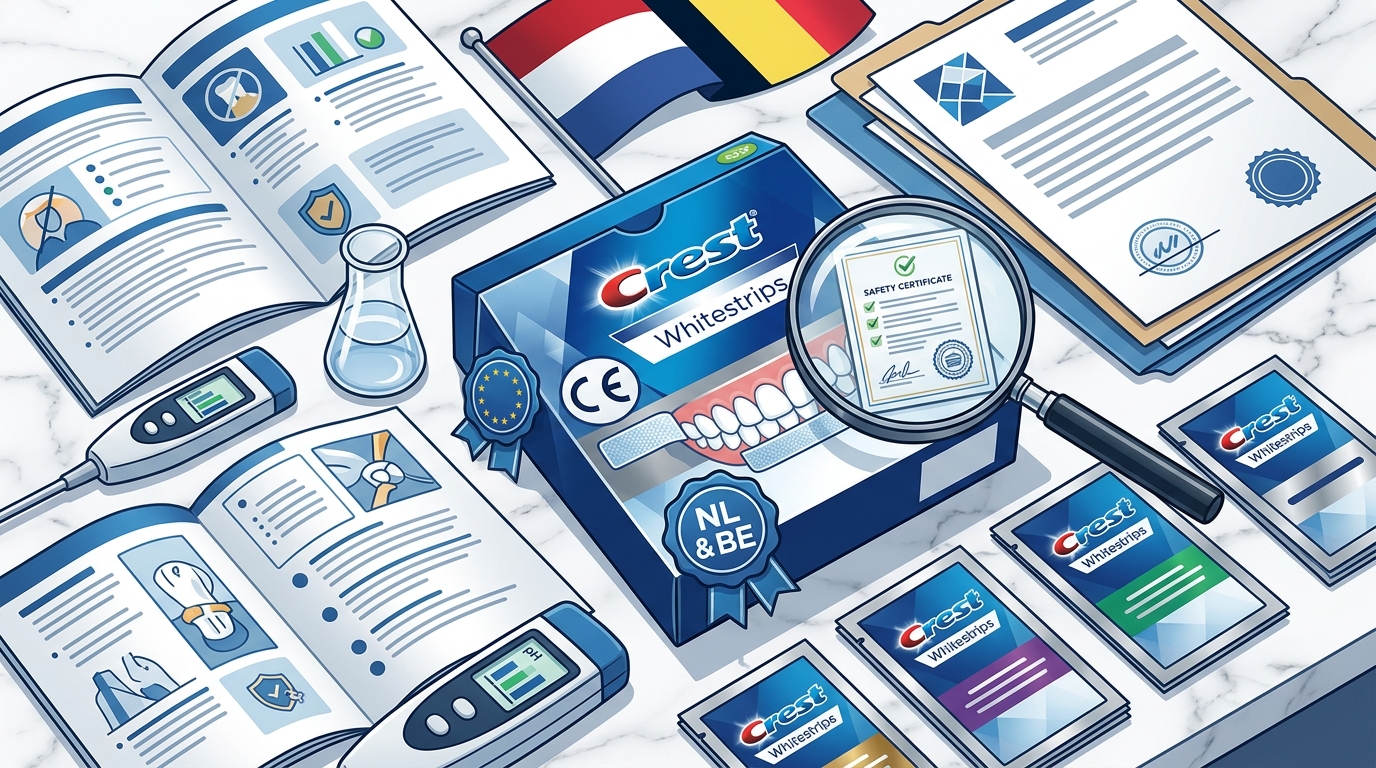
Consumer Certification Checklist
To ensure you are purchasing safe and compliant teeth whitening strips in the Netherlands and Belgium, use the following checklist. This process helps you identify reputable retailers and avoid counterfeit or unsafe products.
- Verify the Responsible Person: Check the product packaging or website for the name and address of the EU-based Responsible Person.
- Check Ingredient Lists: Ensure the hydrogen peroxide concentration is clearly stated. If it is above 0.1%, verify that the retailer provides safety warnings.
- Review Safety Data Sheets: Reputable retailers provide access to safety data sheets or product information files upon request.
- Confirm Local Language Support: Ensure that the retailer provides customer support and product information in Dutch or French.
- Look for Trust Seals: Check for recognized trust seals such as Trustpilot or other consumer protection badges that indicate verified customer reviews.
- Validate Return Policies: Read the return policy carefully to understand your rights in case of adverse reactions or product defects.
Key Takeaways
- The EU Cosmetic Regulation (EC) No 1223/2009 is the primary legal framework governing teeth whitening strips in the Netherlands and Belgium.
- Products containing more than 0.1% hydrogen peroxide are restricted and require professional supervision or specialized online sales channels.
- The Dutch NVWA and Belgian AFMPS enforce strict labeling and safety standards for all cosmetic products sold in their respective countries.
- Consumers must verify the presence of an EU-based Responsible Person to ensure product traceability and legal accountability.
- Reputable retailers provide detailed safety warnings, ingredient lists, and clear return policies to protect consumer health.
- Marketing claims for whitening strips must be cosmetic in nature and cannot include unsubstantiated medical benefits.
- Buying from specialized online retailers like Whitestrips-shop.nl often provides access to higher-concentration, more effective products that are not available in general retail.
Frequently Asked Questions
Are teeth whitening strips safe to use at home?
Yes, when used according to the manufacturer's instructions, teeth whitening strips are safe for most people. However, those with sensitive teeth or gum disease should consult a dentist first. The safety of the product depends on the concentration of hydrogen peroxide and the quality of the manufacturing process.
What is the maximum hydrogen peroxide concentration allowed in the EU?
For products available to the general public without professional supervision, the maximum concentration is 0.1%. Products with higher concentrations are classified as restricted cosmetics and can only be sold through specialized channels with appropriate safety warnings.
How can I verify if an online retailer is compliant in the Netherlands?
Check for a Dutch address and customer service number. Reputable retailers will also display their terms and conditions, return policy, and contact information clearly. You can also verify the retailer's reputation through independent review platforms like Trustpilot.
What are the regulations for selling whitening strips in Belgium?
In Belgium, the AFMPS oversees the safety of cosmetic products. Retailers must ensure that all product information is available in French and Dutch. Marketing claims must be cosmetic and not medical. The retailer must also have a clear return policy that complies with Belgian consumer law.
Can I return whitening strips if I am not satisfied?
Due to hygiene regulations, opened cosmetic products are generally non-returnable. However, if the product is defective or not as described, you have the right to a refund or replacement. Always check the specific return policy of the retailer before purchasing.
Do I need a prescription to buy whitening strips online?
No, you do not need a prescription. However, for products with high hydrogen peroxide concentrations, retailers are required to provide safety warnings and advise consulting a dentist. The sale is regulated to ensure that consumers are aware of the potential risks.
What is the difference between Crest Whitestrips and generic brands?
Crest Whitestrips are manufactured by Procter & Gamble and undergo rigorous testing for safety and efficacy. They are widely recognized as a gold standard in at-home whitening. Generic brands may vary in quality and safety standards, so it is important to choose reputable retailers that source authentic products.
Secure Your Safe Whitening Experience
Choosing the right teeth whitening strips is about more than just achieving a brighter smile. It is about ensuring your safety and complying with the strict regulations of the Netherlands and Belgium. By purchasing from specialized retailers like Whitestrips-shop.nl, you gain access to authentic, high-quality products that meet these rigorous standards. Visit our webwinkel today to explore our range of certified Crest Whitestrips and start your journey to a confident, white smile.