

Coffee is one of the world's most beloved beverages, yet its dark pigments can leave stubborn stains on your teeth over time. The tannins in coffee cling to tooth enamel and gradually create a yellow or brown tint that regular brushing alone cannot fully eliminate. The good news is that several proven methods, from daily habits to professional-grade whitening strips, can restore your smile to its natural brightness. In this guide, we walk you through the most effective ways to tackle coffee stains, backed by dental research and practical advice you can start using today.
Why Coffee Stains Your Teeth
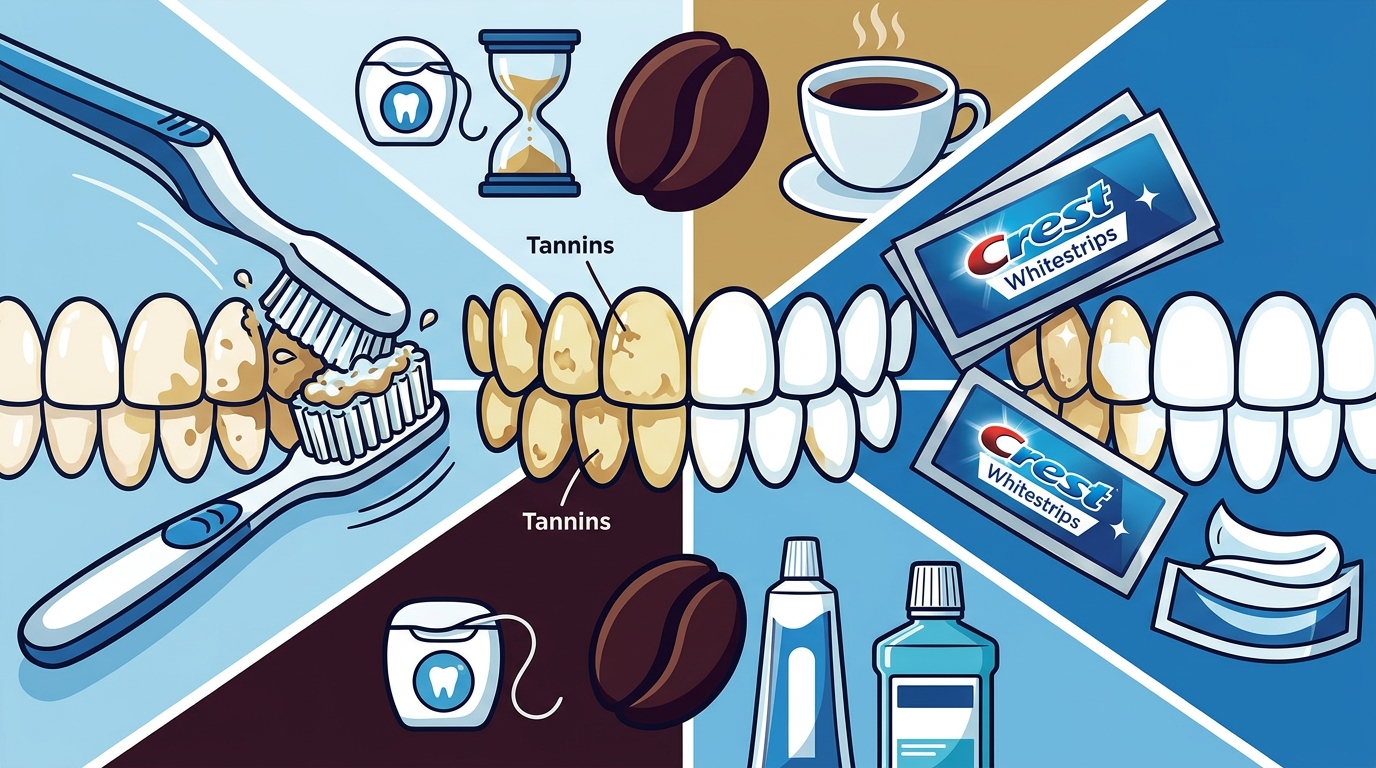
Tannins are natural organic compounds found in coffee that easily adhere to tooth enamel, causing discoloration over time. A tannin is a polyphenolic compound that binds to proteins and other organic molecules on the tooth surface, creating a layer of pigmentation that deepens with repeated exposure.
Beyond tannins, coffee's mild acidity can open microscopic pores in your enamel, allowing chromogens (dark pigment molecules) to penetrate and settle in. This is why brushing only removes the surface layer; deeper, oxidized stains require chemical whitening to reverse.
Daily Habits That Prevent Coffee Stains
Prevention is always easier than removal. Rinsing your mouth with water immediately after drinking coffee helps wash away pigments before they bind to enamel. Drinking through a straw reduces direct contact between coffee and your front teeth.
Brushing and Flossing Routine
Brushing your teeth at least twice a day and flossing daily prevents coffee stains from setting in. Wait at least 30 minutes after drinking coffee before brushing, as the acidity temporarily softens enamel. An ADA-approved fluoride toothpaste offers the best baseline protection.
Diet Tips
Crunchy fruits and vegetables like apples and celery act as natural scrubbers, helping remove surface plaque and light staining between brushings. Adding milk to your coffee can also reduce its staining potential by binding tannins before they reach your teeth.
Whitening Toothpaste: Your First Line of Defence
Whitening toothpaste is a toothpaste formulated with mild abrasive particles or chemical agents designed to remove surface stains and brighten teeth over time. Research published in the International Journal of Dentistry (2024) found that sodium hexametaphosphate (SHMP) toothpastes achieved approximately 80.83% lightness recovery on coffee-stained enamel, outperforming hydrogen peroxide (70.83%) and sodium bicarbonate (71.67%) formulations.
For daily maintenance of mild stains, a quality whitening toothpaste is a solid starting point. However, for moderate to heavy coffee discoloration, toothpaste alone may not deliver the dramatic results you want.
Hydrogen Peroxide Whitening Strips: The Most Effective Home Solution
A hydrogen peroxide whitening strip is a thin, flexible strip coated with an enamel-safe peroxide gel that you apply directly to your teeth. Research shows that hydrogen peroxide strips are more effective than whitening toothpaste for removing coffee stains because the peroxide penetrates beneath the enamel surface to break apart deep pigment molecules.
Why Crest Whitestrips Stand Out
Crest Whitestrips, made by Procter & Gamble, have been the best-selling at-home whitening product in the United States for over 16 years with more than 40 million users. Their Advanced Seal Technology keeps strips firmly in place during treatment, allowing you to talk and drink water while whitening.
For heavy coffee stains, the Crest Whitestrips Professional Effects deliver up to 18 shades whiter in 20 days with results lasting 12 months or more. If you have sensitive teeth, the Crest 3D Whitestrips Sensitive with LED Light combines a mild formula with LED acceleration to remove over 20 years of stubborn stains.
Quick Results Option
Need results fast? The Crest Whitestrips 1Hour Express show visible improvement within just one hour, making them ideal before a special event.
Natural Home Remedies Worth Trying
Baking Soda
Baking soda is a mild abrasive that can scrub away surface coffee stains without damaging enamel when used sparingly. Mix it with water to form a paste and brush gently once or twice per week. Overuse can wear down enamel over time, so moderation is key.
Oil Pulling
Oil pulling is an ancient practice that involves swishing coconut oil in your mouth for 15 to 20 minutes to lift surface stains and remove bacteria. While scientific evidence for its whitening efficacy is limited, many people report brighter teeth with consistent use.
Apple Cider Vinegar
The mild acidity in apple cider vinegar can help loosen surface stains when diluted with water and swished briefly. However, use this method no more than once a week, as frequent exposure to acid erodes enamel.
Professional Dental Treatments
For deeply ingrained coffee stains that resist at-home methods, professional teeth whitening at a dentist's office offers the most powerful results. In-office treatments use higher concentrations of hydrogen peroxide or carbamide peroxide under controlled conditions, delivering dramatic whitening in a single visit.
Regular dental cleanings every six months are also essential. A dental hygienist uses specialized tools to remove plaque, tartar, and surface stains, creating a clean foundation for any whitening treatment you pursue at home. Read more about whitening safety and what to expect.
Method Comparison: Effectiveness at a Glance
| Method | Best For | Effectiveness | Time to Results | Enamel Safety |
|---|---|---|---|---|
| Whitening toothpaste | Mild surface stains | Moderate (70-81% lightness recovery) | 2-6 weeks | High (daily use) |
| Hydrogen peroxide strips (e.g., Crest Whitestrips) | Moderate to heavy stains | High | 3-20 days | High (enamel-safe gel) |
| LED + whitening strips | Deep, long-term stains | Very high | 14 days | High |
| Baking soda paste | Light surface stains | Low to moderate | Several weeks | Moderate (limit use) |
| Oil pulling | Maintenance | Low | Weeks to months | High |
| Professional whitening | Severe stains | Very high | 1-2 visits | Monitored by dentist |
Key Takeaways
- Coffee stains teeth because tannins and chromogens cling to enamel and penetrate microscopic pores.
- Hydrogen peroxide whitening strips outperform whitening toothpaste for coffee stain removal, according to clinical research.
- Crest Whitestrips Professional Effects can whiten teeth up to 18 shades in 20 days.
- Prevention matters: rinse with water after coffee, use a straw, and brush twice daily.
- Baking soda is effective for mild stains but should be limited to 1-2 times per week to protect enamel.
- For sensitive teeth, opt for a gentle formula like Crest 3D Whitestrips Sensitive with LED Light.
- Schedule professional dental cleanings every six months for a clean foundation.
Frequently Asked Questions
Can coffee stains on teeth be fully removed?
Yes. Surface stains respond well to whitening toothpaste, while deeper stains can be effectively treated with hydrogen peroxide strips or professional whitening. Consistent use of an at-home whitening product like Crest Whitestrips Glamorous White can eliminate years of accumulated discoloration.
How long does it take whitening strips to remove coffee stains?
Results depend on severity. Mild stains may improve within 3 days using express strips, while moderate stains typically require a full 14- to 20-day treatment cycle for optimal results.
Are whitening strips safe for enamel?
Yes. Crest Whitestrips contain the same enamel-safe peroxide ingredient that dentists use. It is recommended to use a maximum of two treatment cycles per year and wait at least six months between treatments.
Does adding milk to coffee reduce staining?
Yes. Casein, a protein in milk, binds to tannins and reduces their ability to stick to enamel. This does not eliminate staining entirely but can slow it down noticeably.
Is baking soda safe for daily use on teeth?
No. While baking soda is a gentle abrasive effective against surface stains, daily use can wear down enamel. Limit its use to once or twice per week.
Do LED whitening kits actually work?
Yes. LED light accelerates the hydrogen peroxide bleaching process. Products like the Crest 3D Whitestrips Professional White with LED Light weaken stains so the peroxide works more efficiently, with results that can last up to three years.
How can I maintain white teeth if I drink coffee every day?
Rinse your mouth with water after each cup, use a whitening toothpaste daily, drink through a straw when possible, and consider a whitening strip treatment every six months. Check out real customer reviews to see how others maintain their results.
Get Started With a Brighter Smile
Ready to remove coffee stains and reveal a whiter, more confident smile? Browse the full range of original Crest Whitestrips starting at just €37.95 with free shipping in the Netherlands and Belgium. Every order ships the next business day in discreet packaging, straight through your letterbox.