
Do Whitening Strips Work on Stained Teeth? The Evidence-Based Guide
If you have ever looked in the mirror and wondered whether at-home whitening strips can actually remove coffee, tea, or tobacco stains, you are not alone. Millions of people worldwide rely on whitening strips as a convenient, affordable alternative to costly dental clinic treatments. But do they really deliver results on stained teeth? In this guide we break down the science, compare stain types, outline realistic expectations, and help you choose the right product for your smile. Whether your discoloration is mild or moderate, the answers below are grounded in clinical research and real-world user data.
How Whitening Strips Remove Stains
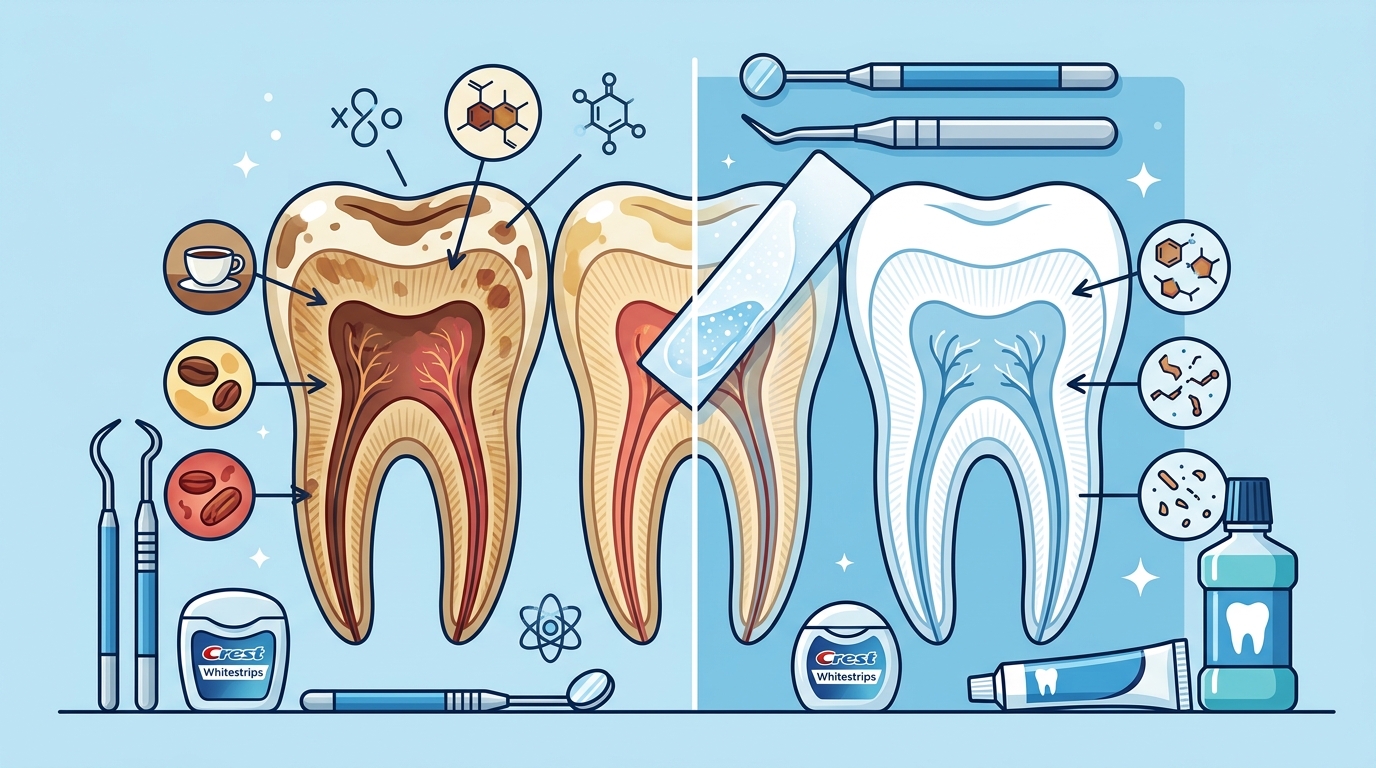
Whitening strips are thin, flexible plastic films coated with a gel containing a bleaching agent, typically hydrogen peroxide or carbamide peroxide. Carbamide peroxide is a compound that breaks down into hydrogen peroxide when it contacts water. When you place the strip on your teeth, the peroxide penetrates your enamel and reaches the deeper dentin layer, where it oxidises pigmented molecules called chromogens.
Crest Whitestrips use patented Advanced Seal Technology that keeps the strip firmly in place during daily activities such as talking or walking. This consistent contact between the gel and your enamel is what makes peroxide-based strips more effective than rinses or toothpastes alone.
Extrinsic vs. Intrinsic Stains: What Strips Can Fix
Extrinsic Stains
Extrinsic stains are discolorations on the outer enamel surface caused by coffee, tea, red wine, tobacco, and highly pigmented foods. According to dental professionals, whitening strips are most effective on these surface-level stains, oxidising them to reveal a brighter smile.
Intrinsic Stains
Intrinsic stains develop inside the tooth structure due to ageing, medications such as tetracycline, or excess fluoride exposure during childhood. Whitening strips are less effective on intrinsic discoloration, which may require professional in-office treatment for noticeable improvement.
What About Dental Work?
As noted on the Whitestrips-shop.nl FAQ page, Crest Whitestrips work only on natural teeth. Crowns, veneers, and fillings will not change colour, so keep that in mind if you have visible dental restorations.
What Clinical Studies Say
A 2020 systematic review and meta-analysis published in the Journal of Esthetic and Restorative Dentistry compared whitening strips to dentist-supervised at-home bleaching. The study found that while supervised treatments produced slightly greater colour change on a spectrophotometer, the difference was undetectable by the human eye. This suggests strips deliver results that are clinically comparable for everyday purposes.
Research published by Frontiers in Dental Medicine confirmed that peroxide-based strips are effective mainly on extrinsic stains, with moderate results on mild intrinsic discoloration from ageing.
Realistic Timeline for Results
How quickly you see results depends on the severity of your staining and the product strength. The Crest Whitestrips Professional Effects ADVANCED can show visible improvement in as little as three days, with full results after 20 days of 45-minute daily sessions. For mild surface stains, lighter-duty options like the Crest Whitestrips Vivid White may deliver noticeable change in under two weeks with just 30 minutes per day.
After completing a full treatment cycle, results typically last between 6 and 18 months depending on your diet and oral hygiene habits.
Whitening Strips vs. Professional Treatments
| Factor | At-Home Whitening Strips | Dentist-Supervised At-Home Bleaching | In-Office Whitening |
|---|---|---|---|
| Active Ingredient | Hydrogen peroxide (6-14%) | Carbamide peroxide (10-22%) | Hydrogen peroxide (25-40%) |
| Typical Duration | 10-20 days | 2-6 weeks | 1-2 sessions |
| Average Cost (NL) | From €37.95 | €200-€400 | €350-€700+ |
| Shade Improvement | Up to 28 shades (ADVANCED) | 4-8 shades | 6-12 shades |
| Convenience | Use anywhere, anytime | Requires custom tray from dentist | Must visit clinic |
| Best For | Extrinsic and mild intrinsic stains | Moderate stains | Severe or stubborn stains |
How to Maximise Your Whitening Results
Preparation
Brush your teeth gently with water before applying strips. Clean, dry enamel allows the peroxide gel to make direct contact. Do not use toothpaste right before application, as it can leave a residue that blocks absorption.
During Treatment
Follow the recommended application time precisely. For the Professional Effects ADVANCED, that means 45 minutes per day for 20 days. Consistency is essential; skipping days reduces cumulative results.
After Treatment
Avoid dark-coloured foods and beverages for at least 30 minutes after removing your strips. Using a whitening toothpaste from the Crest range can help maintain brightness. Check out our five tips for whiter teeth for more practical advice on extending your results.
Key Takeaways
- Whitening strips containing hydrogen peroxide are clinically proven to lighten teeth, primarily by removing extrinsic stains from coffee, tea, wine, and tobacco.
- A 2020 meta-analysis found that the colour difference between strips and supervised at-home bleaching is undetectable to the human eye.
- Intrinsic stains caused by medication or trauma are unlikely to respond fully to strips and may need professional treatment.
- Crest Whitestrips Professional Effects ADVANCED can remove up to 14 years of coffee or smoke stains in 20 days.
- Results typically last 6 to 18 months when paired with good oral hygiene.
- Strips do not whiten crowns, veneers, or fillings, so consult a dentist if you have visible restorations.
- Temporary tooth sensitivity affects roughly one-third to one-half of users and resolves after treatment ends.
Frequently Asked Questions
Do whitening strips remove coffee stains?
Yes. Coffee stains are extrinsic, meaning they sit on the enamel surface. Hydrogen peroxide in whitening strips oxidises these stains effectively. Most users see noticeable improvement within three to five days.
How long does it take for whitening strips to work?
For mild surface stains, results can appear in as little as three days. Moderate staining may take one to two weeks. A full treatment cycle with Crest Whitestrips Professional Effects ADVANCED is 20 days.
Are whitening strips safe for enamel?
When used as directed, peroxide-based strips approved by organisations like the American Dental Association are generally safe. Overuse, however, can weaken enamel over time.
Can whitening strips fix yellow teeth from smoking?
Tobacco stains are extrinsic and respond well to peroxide-based strips. The Crest Whitestrips Professional Effects ADVANCED is specifically formulated to tackle up to 14 years of smoke-related discoloration.
Do whitening strips work on intrinsic stains?
Strips have limited effectiveness on deep intrinsic stains caused by medication, trauma, or fluorosis. For these cases, a dentist consultation is recommended.
How long do whitening strip results last?
Results typically last between 6 and 18 months. Avoiding staining substances and maintaining good oral hygiene will extend that duration.
Will whitening strips change the colour of my crowns or fillings?
No. Whitening strips work exclusively on natural tooth enamel. Crowns, veneers, and composite fillings remain unaffected.
Is it better to use strips or go to a dentist?
For mild to moderate extrinsic stains, strips offer comparable visual results at a fraction of the cost. Severe or intrinsic staining may require professional in-office treatment for optimal results.
Ready to See the Difference for Yourself?
Explore the full range of original Crest Whitestrips, starting from just €37.95 with free shipping to the Netherlands and Belgium. Browse our online shop, read 500+ verified customer reviews, and choose the treatment that fits your smile goals. Your brighter, whiter teeth are just a few days away.